


Index funds are are designed to buy shares from all of the companies listed on a particular index – which may include Standard & Poor’s, ASX Top 50, 100, 200 and others. Because they are designed to track the market, index funds will follow the market up and down.
When you are choosing an index fund, it is important to think about the diversification that you are getting with the fund. If the index focuses on one type of commodity, you may run a higher risk if the entire market takes a dive in that area.
You can also have a wider diversification by choosing an index with more companies or businesses in it rather than a smaller one. Indexes can be quite small from 50 to over 500 companies.
The larger the number of companies and the more diverse they are the lower your overall risk.
Types of Indexing
There are different types of indexes that you can invest in. A traditional indexing occurs when the fund purchases the same proportion of shares as what is listed in the original index. These types of funds usually carry a name that indicates that it follows a specific index.
Enhanced indexing occurs when the fund is more managed. The managers of the fund try to offset any drops in the market by including other types of investments.
These are closer to managed funds and may include bonds and other investments to offset falls in the market place.
Lower Fees

Fees make a big difference in the return your investment produces
Since an index fund is simply based on the index that it is purchasing from, the management fees are lower than you would find in a managed fund. You may also avoid load fees and transaction fees.
This can increase the amount that you earn on each of the index funds as opposed to a managed fund.
Risk Related to Index Funds
If one particular index were to suddenly plunge, and you had shares in an index fund, your value will drop. Sudden market drops happen from time to time. An example of this is the 2008 economic crisis.
The market usually recovers, but it takes time, and you may lose your money if you need to pull it out of the market during a low time.
Exchange Traded Funds
An exchange traded fund (ETF) is traded on the stock market just like a share would be. It is easy to purchase this type of fund, and the funds value will go up and down according to market conditions.
Many people are moving towards this type of fund because it is easy to deal with and the risk is already spread across a wide variety of stocks.
Some Australian ETFs include:
- Wisdom Tree Australia Dividend Index
- PIMCO Australia Bond Index
- iShares MSCI Australia Small Cap Index fund
ETFs may focus on stocks, bonds, commodities, currency or indexes. When you are considering an ETF, you need to understand what type of investment it focuses on and be sure that you feel that investing in that is a good idea.
Ideally, you should invest in a number of different indexes to help spread your risk.
Buying an Index Fund
Depending on the type of fund, you have the option of purchasing shares in a variety of index funds. Closed funds do not usually allow people to purchase and trade the funds on a daily basis, whereas an ETF is traded constantly throughout the day.
You can use a financial advisor or broker to purchase an index fund, or you can buy one online through an investment website. Remember when you purchase an index fund that you need to be willing to ride out the ups and downs of the market.
Should I Choose an Index Fund or a Managed Fund?
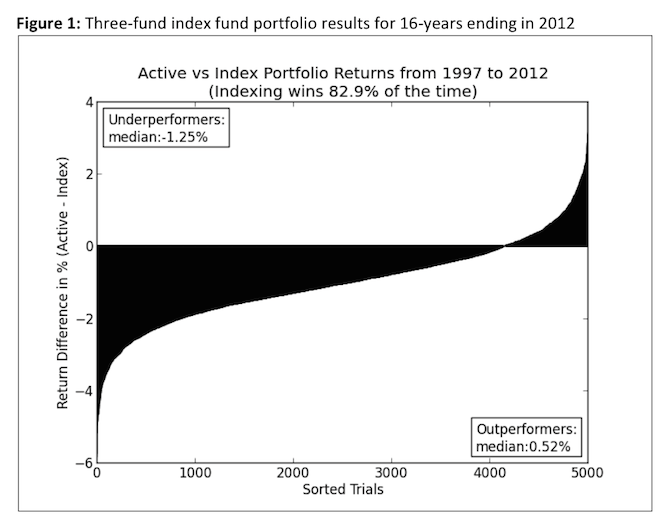
A study by Richard Ferri and Alex Benke found that indexed fund beats actively managed funds 82.0% of the time.
While both types of funds help you to manage risk by spreading the investment over several different companies, you will generally find much lower management fees with an index fund.
Another factor to consider that on average the market index funds perform better overtime than the majority of managed funds. There will always be a few managed funds that perform better than an index fund, but they may not be the same fund every year. It is often easier to invest in an index fund.
When you choose a fund, you need to make sure you understand any fees that come with the fund and to be sure to monitor the fund to make sure it is still performing well. You can ride out the drops in the market and usually gain back any money that you lost.
Additionally, you do not need to worry when the management of an index fund changes, because the investing strategy will remain the same no matter who is in charge, whereas the strategy might change slightly with a managed fund.
“A very low-cost index is going to beat a majority of the amateur-managed money or professionally managed money,” Warren Buffett.
Index Fund History
Index funds were first considered an option when John Bogle pointed out that the majority of managed funds were not beating out the market averages. Vanguard opened the first index fund in 1976 in the United States. Since then the popularity of index funds has grown significantly.
ETFs (Exchange-Traded Funds) were first introduced in 1989 and have grown in popularity since then.
In Australia the first index funds for investors became available from Vanguard in 1996. The funds began to be a part of the superannuation accounts in 2007. Vanguard began offering ETFs to investors in 2009.
Index funds offer a safe alternative to people who want to invest, but also want to play it safe. Economic theory points to index funds as allowing the market to play to its strengths while the manager of managed funds keep focusing on a way to beat the market and at times may end up losing money while looking for ways to make more of it.
If you trust that the market or index will continue to grow then index funds are a good option.
