


With ownership comes great responsibility–and a whole lot of potential to screw up.
That’s why, lately, there’s been talk about the risks involved in buying property. Just because real estate prices are falling, people tell us, doesn’t mean we should run off and buy an estate and a few hundred cattle. It will only lead to financial ruin.
But the reality is that owning a home will probably save you hundreds of thousands of dollars over your entire life—one of the smartest financial moves you can make.
A common argument against owning a home is the “phantom costs” generated by unexpected fees and repairs, which can amount to hundreds of thousands of dollars more than the costs associated with renting.

But when properly planned and executed, buying a home can be a terrific investment. You are paying for housing whether you buy or rent, so why not invest your dollars in something you own? Not only can homeowners deduct mortgage interest and property taxes from their income, but they also enjoy 30 times the net worth that non-homeowners do, when it’s all said and done.
Much of the recent craze surrounding renting versus buying stems from being uninformed. For instance, during the most recent housing crisis in the US, the majority of collapsed mortgages and defaults were on homes that were purchased with very little money down. As you’ll read in a minute, putting money down on a house dramatically reduces the risk of forclosing or accumulating debt later in life.
But people don’t always make decisions with the future in mind.
Which is why we’ve curated a short guide on buying a home the right way, guilt free and confident in your investment. If you follow these steps, you’ll be glad to call your living space your own.
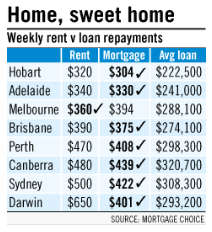
Buying is cheaper than renting in nearly every Australian city.
1. Ask yourself why you want a home.
Figuring out why you want a home is a critical first step. What’s the purpose of the home? What do you want to do with it? Are you going to live in it? Are you going to rent it? Answering these questions will determine what kind of loan structure you’ll need and what size house makes the most sense given your immediate and long-term goals.
2. Crunch the numbers.
First, you have to determine what kind of property you can afford, including the fees that come with it. All of this rests on how much you can set aside each month.
Try to keep your house payment cost to about 25% of your income. If you have additional debt obligations, you may want to work on lowering it even more. But remember that the longer you take to repay the loan, the more interest you’ll accumulate. Use a mortgage calculator to find the right balance.
Loan Amount Term Rate Monthly Payment
$150,000 30 years 5% $805.23
$150,000 20 years 5% $989.93
$150,000 15 years 5% $1,186.19
$150,000 30 years 6% $899.33
$150,000 20 years 6% $1074.65
$150,000 15 years 6% $1265.79
3. Account for fees and taxes.

This may be the most important point of all: Be prepared to pay various fees associated with buying your home. Some of these include:
–mortgage application fees
–downpayment (about 20% of the purchase price)
–realtor commission
–closing costs associated with your loan
–stamp duty
–insurance
–property inspection fee
–conveyancer fee
–property taxes
–land transfer registration fee
–maintenance expenses (water, trash collection, etc.)
–home equity loan (for upgrades and repairs)
It is absolutely imperative that you include these costs in your budget going forward. Setting up a separate savings account specifically for miscellaneous fees can save you a lot of heartache in the end.
*A note on taxes: In Australia, there are no tax implications for the home that you live in, provided you don’t use it to produce income and it’s on 2 hectares of land or less. There are also no tax implications if you build or renovate your own home for private purposes.
4. Consider a first-home saver account.
If you open a first home saver account with the Australian government, the government will add money to your account and tax your account earnings at a low 15% to help you save for your first home. First home saver accounts offer a tax-effective way of saving for your first home through a combination of government contributions and low taxes.
If you open a first home saver account, the government will add money to your account and tax your account earnings at a low 15% to help you save for your first home.
In the States, first-time homebuyers can apply for Federal Housing Administration (FHA) loans, which require just a 3.5% down payment.
5. Do your market research.

When you begin your search for property, be sure you have your priorities and facts straight. Know what features you would like and where you are willing to compromise. Know what’s average market price at the time of your search, and where you can negotiate.

Also, come up with a backup plan in case you need to sell or rent sooner than anticipated. A few tips:
–Look for proximity to public transport to maximize re-sale potential.
–Make sure the second bedroom is leasable and that you have good living space in case you need to get a tenant in to split costs.
–Ask your real estate agent whether they think the property is rentable and, if so, how much it could rent for.
–Be sure you get a vendor’s statement so that you are aware of the dimensions of the block, the zoning, any statutory warnings from the vendor, and things you may not think about, like whether the property is in a bushfire-prone area.
All of this may or may not include hiring a realtor. A good realtor will make the home buying process much easier, but it is an added expense. It’s a good idea to ask friends and family for recommendations, or to search for highly rated realtors in your area online.
6. Find the right mortgage.
When choosing a mortgage, there are a number of things you need to understand. You are looking for a traditional mortgage with a fixed interest rate. This is he best option, even if the initial interest is a bit higher than a variable interest rate mortgage. The fixed interest rate will stay the same through the life of the loan, while the variable interest rate will adjust up, and you will likely end up paying a higher interest rate over the life of the loan.
Just like applying for a credit card, whether you qualify for a particular home loan depends on your financial history. Lenders will look at your pay stubs, employment forms, and tax returns going back two years, as well as your credit score to determine eligibility.
If you do not qualify for a mortgage, you can take a year or two to repair your current situation so that you can get a mortgage in the future. You will need to repair your credit history and try to save up a larger down payment for a home.
Do as much research as you can before borrowing from a bank or independent institution. Ask around, read reviews. Be sure you know the terms of agreement by heart. All this can prevent you from issues such as lead time misalignment–when the date you receive your institution’s funds doesn’t match up with the date you agreed to sign the papers on a new home.
7. Apply for pre-approval.
Getting pre-approved for a mortgage will speed up the home buying process, and it will give you an idea of the price range for the homes that you can afford to buy.
The bank may be willing to lend you more than what you think you can afford. You should stick to the amount that you have determined that you can afford. You do not want to overextend yourself when you are buying a home. A mortgage broker will work with a number of banks and lending institutions to help you find the best rate and terms for your home loan.
Some banks have mortgage brokers and work to help you find the best mortgage rates. Other mortgage brokers work independently from banks. You can find a mortgage broker through your bank or by asking friends and family members for referrals to mortgage brokers that they trust.
8. Make the down payment.

Many collapsed mortgages and defaults are on homes that were purchased with very little money down. Have a conversation with your loan officer about how you plan on putting together the funds required for down payment.
A down payment shows the bank that you have handled your money responsibly. Many banks are only willing to lend up to about eighty percent of the home’s value. Saving up the down payment will lower the interest rate on your mortgage, because the loan to value ratio is smaller.
A down payment can also help you to afford a nicer home, since it is reducing the amount that you have to borrow to find the home you want. If you are looking at homes, and cannot find anything you like in your price range, then work on saving up a larger down payment and start shopping in another year.
This can help you to find a home that you love instead of settling on a home that is just okay. Saving up a down payment is just another way that you can prove to yourself that you are ready to buy a home.
If you can’t put down 20%, you should seriously reconsider whether you’re ready to buy a home.
9. Easy on the credit.

Don’t apply for new credit while you’re in the home buying process. New credit accounts for as much as 10% of your credit score. Newly opened trade lines and credit inquiries can have a negative impact on your credit score. Every point in your credit score matters and even a small drop in your credit score could cause you to receive a higher interest rate for your loan or, worse yet, cause your loan to be denied.
What’s more, high credit utilization can have a significant impact on your credit score even if you pay your credit cards in full each month. Avoid large purchases that could increase your credit utilization in the 30 days that lead up to your mortgage application. A general rule of thumb is to stay under 30% utilization, but the lower the better.
10. Make an offer and set a “walkaway price.”
If making an offer, avoid the temptation to start too low, as the vendor may not take you seriously. An initial offer of around 15 percent below the asking price is a good starting point. Before talking numbers, ask if you’re the first person to make an offer and, if there have been others, ask why they were rejected. This will give you an idea of what the vendor wants.
If you go to the auction, be ready. Knowing what to expect will be a huge advantage. Ensure you take a personal cheque book along – if you’re the winner, you’ll be expected to pay the deposit immediately.
Finally, set a maximum “walk away” price and stick to it; don’t be afraid to back out if the numbers start hitting the roof.
11. Double-check the contract.
Get a conveyancer to look over the contract before you sign it. They will confirm that the vendor actually has the right to sell the property and there is nothing to impede on the mortgage or re-sale.
12. Schedule a building inspection.
Organize a professional building inspection during the cooling-off period after making an offer. Prior to making an offer, have a friend or family member with some building knowledge go through the property and check for any obvious flaws. A building inspector knows what to look for and can tell the difference between a great investment and a house that will need significant work to cover up structural defects and dodgy cover-up jobs.
13. Don’t become emotionally attached before the paperwork is signed.
One of the biggest problems for homebuyers is emotional attachment. You tour the home, begin the process of making it your own, imagine yourself fulfilling an old dream–only to be duped by a faulty contract. See the homebuying process for what it is–a financial transaction—and not an emotional release. Then, once the papers are signed and the keys handed over, it’s all yours.
